

Chiropractic marketing is how a practice gets found, chosen and booked by new patients. The strategies that work best in 2027 are a strong Google Business Profile, a website with online booking, condition-specific pages, local SEO, reviews, Google and Facebook ads, and fast follow-up on every lead. This guide covers 12 of them, with what each costs and where to start.
Most chiropractor marketing advice is a list of 50 tactics with no order. That's how practices end up posting on TikTok while their Google profile has 11 reviews and no booking link. The 12 strategies below are in the order we set them up for our own chiropractic clients: the foundation first, then the channels that bring in new patients, then the ones that keep them coming back.
If you only have time for three, do numbers 1, 5 and 8. They cost little or nothing and make every other channel work better.
Table of Contents
Chiropractor marketing is everything that turns a stranger with back pain into a booked new patient, and a new patient into someone who finishes their care plan and refers friends. It covers three jobs:
Most practices are decent at the first job and leak patients in the second and third. The strategies below fix all three.
When someone searches "chiropractor near me," the first thing they see is usually the map pack: three practices with stars, photos and a call button. Your Google Business Profile decides whether you're in it.
This is free, takes an afternoon, and for many practices it brings in more calls than the website does. Our guide to SEO for chiropractors covers the profile in more detail.
Your website has one job: turn visitors into booked appointments. Pretty design helps, but these details matter more:
Need inspiration? See our list of the best chiropractic websites and what makes each one work.
People don't search for "chiropractic care." They search for their problem: "chiropractor for sciatica," "neck pain relief," "car accident chiropractor." A single services page can't rank for all of those.
Give each condition you treat often its own page: sciatica, neck pain, headaches and migraines, low back pain, auto injury, sports injuries, pregnancy care. On each page, explain the symptoms in plain words, how you treat it, what the first visit looks like and how to book. Use these same pages as the landing pages for your ads, so someone who clicks an ad about sciatica lands on a page about sciatica.
Auto injury pages deserve special attention. Those patients often have insurance coverage for a full course of care, and the searches are less competitive than general terms.
Local SEO is what moves you up in both the map pack and the regular results below it. Beyond your Google profile, the work comes down to:
SEO takes months to pay off, but once you rank, every new patient it brings costs you nothing extra. See our full guide to SEO for chiropractors, including a list of chiropractic keywords to target.
Reviews do two jobs at once. They help you rank in the map pack, and they're the main thing people read before they call. A practice with 240 reviews at 4.9 stars wins over one with 18 reviews almost every time.
Aim for a few new reviews every week, not a burst once a year. Recent reviews count for more.
Google search ads put you at the top of the page when someone is ready to book. They cost more per lead than social ads, but the people clicking already want a chiropractor.
In 2026, the average cost per lead on Google search ads for physicians and surgeons was $40.04, according to WordStream and LocaliQ. To keep your costs below that:
Our patient acquisition benchmarks show how to work backward from the number of new patients you want to a monthly budget.
Facebook and Instagram ads reach people in your area who aren't searching yet but have been putting off dealing with their back or neck. They're usually the cheapest source of paid leads. The 2026 average was $32.14 per lead for physicians and surgeons, and our Moss Family Chiropractic campaign got leads for $4.26 each, with 7 new patients from $221.75 in ad spend.
What makes chiropractic Facebook ads work:
We cover costs, examples and targeting in our guide to Facebook ads for chiropractors.
This is the most overlooked strategy on the list, and it often matters more than the ads themselves. Call-tracking company Liine analyzed 325,000 new patient inquiries at specialty practices and found that practices that called web-form leads automatically booked 55% of them, versus 19% for practices that didn't.
That means two practices with the same ad budget can get three times different results based only on follow-up. To fix it:
Read more in our guide to lead generation for chiropractors.
Referred patients trust you before they walk in, finish their care plans more often and cost almost nothing to get. Two kinds of referrals are worth building on purpose:
See our full guide to chiropractic referrals.
Getting a new patient is expensive. Keeping one costs a few cents per email. A simple email program does three things: reminds patients to finish their care plans, brings back patients who dropped off, and keeps you top of mind so they refer friends.
Start with a monthly newsletter with one helpful tip, one patient story and one reason to book, plus an automatic reactivation email for anyone who hasn't visited in six months. For topics, see our chiropractic newsletter ideas and our guide to chiropractic email marketing.
Social media rarely brings in new patients on its own, but it makes every other channel work better. People who've seen you explain a stretch or answer a question on video already feel like they know you when they see your ad or Google profile.
Keep it simple: one or two short videos a week showing a stretch, a desk setup tip, a patient question or a look inside your office. Post the same video to Instagram Reels, Facebook, TikTok and YouTube Shorts. See our guides to YouTube for chiropractors and TikTok for chiropractors.
In-person events build trust faster than any ad. A short evening workshop on back pain, a lunch-and-learn at a local employer, a booth at a health fair or a "Dinner with the Doc" event can each bring in several new patients at once. Health 1st Center combined a patient dinner event with Facebook ads and added 77 new patients in three months.
Bring a sign-up sheet or a simple offer for attendees, and follow up within a day. For more in-person ideas, see how to get more chiropractic patients.
Perhaps one of the biggest mistakes business owners make—and the #1 reason so many fail—is that they choose an idea that sounds good and they run with it.
Although it’s possible to achieve a modicum of success, the problem with this approach is that developing a successful chiropractic marketing strategy starts way before any tactics come into play.
First, it’s imperative to:
Without these crucial ingredients, the tactics and strategies we’ve covered in this guide mean nothing. Sure, you can create content and offers that get a few nibbles, but it’s nothing compared to what you’ll gain when you’re sending the right message to the right people at the right time.
Let’s explore these concepts further.
Arguably the most important element of your overall marketing message, a value proposition is a clear statement of tangible results a buyer derives from using your products and services.
It’s a promise of value to be delivered and it answers the following questions:
Your value proposition guides every marketing message from the copy on your website to the ads you run on social media.
In this example, we wrote website header copy based on the value proposition statement we created for a group of chiropractors who specialize in treating scoliosis patients conservatively.

Since there was a clinical study conducted on the effectiveness of their treatment modalities, we were able to incorporate that proof element into the copy.
Now it’s not easy defining your value proposition when you’re struggling to identify what’s unique about you, your business, or your product and service offerings. For most chiropractors, the techniques are similar and the desired outcomes are the same.
To overcome this problem, try to focus on your distinctive competencies. These can be based on technology you use in your practice, your position in the local market place, your range of products and services, the prices of your offerings, your unique protocols, your philosophies, your people, your target audience, specific problems you treat, customer satisfaction, or anything else that differentiates you from others. Remember, you’re working on a local level, so even if you’re not unique on a grand scale, you are unique to your community.
If you need help crafting your value proposition statement, Tor Gronsund offers seven proven templates for writing value propositions that work.
Okay, let’s move on to the next key ingredient for making a campaign successful.

Everyone believes they know their customers, but how true is that?
Successful marketing deeply depends on effective communication. Speaking to the wrong person is guaranteed to get you nowhere fast, which is why it’s essential to create buyer personas representative of your ideal patients. After all, the needs of a new mother with a colicky baby are very different from a construction worker with back pain or someone who needs pain relief from a car accident injury.
Basically, a buyer persona (a.k.a. customer avatar) is an archetypical representation of a real person who might be interested in what your practice has to offer. This individual has a specific set of traits and follows a decision-making process influenced by a multitude of factors and biases.
Here are just some of the data points a buyer persona can include:
Understanding your patients in terms of their problems, goals, limitations, desires, values, beliefs, and capabilities not only ensures you create the right offer and pitch for the right person, but it also shapes your ad copy by helping you identify the right language, tone, voice, and style for motivating action. You’ll be equipped to create hyper-targeted ads for each of your patient segments so that you’re not wasting precious marketing dollars delivering ads to people who aren’t interested in your offering.
With that said, it’s time to look at how the marketing tactics presented throughout this post fit into your buyer’s journey.
Generally divided into three stages, your buyer’s journey is a research and decision process that looks like this:
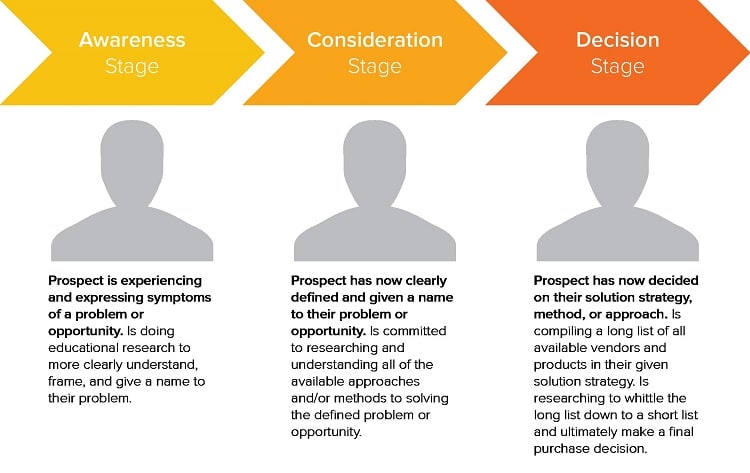
(Source: Hubspot)
During the awareness phase, potential patients are coming to the realization that they have a problem or need. They’re open to solutions and have started researching the pain in order to understand it and better define it. They’re often using search terms related to symptoms, such as ‘how to get rid of lower back pain’ or ‘headache causes.’ In the offline world, ads and materials related to their problems capture their attention.
At this stage, you should be producing and promoting valuable educational content focused on your prospect’s pain, as well as ads that generate awareness about the issue.
Now consider which marketing channels and tactics you might use.
A virtual office tour or patient testimonial make zero sense here because people don’t know you, your business, or what you do.
Instead you’ll use channels that help you meet them at this initial level of awareness. Therefore, you’ll have your website, GMB listing, and social media profiles set up so that people can find you. You’ll be implementing local SEO using pain and solution-focused search terms. You’ll be publishing written, visual, video, and audio content via your blog, podcast, social media channels, and guest blogs. You’ll be buying Google Ads and Facebook Ads.
Offline, you might be leveraging billboard ads, TV ads, pamphlets, sponsorships, or any one of the other methods that will draw attention to your practice while helping people understand their problem the potential solution.
Starting to see how this works?
Let’s carry on.
We’re at the point now when prospective patients have clearly defined their need and are weighing up their options. Although they might know about your practice, they’re not quite ready to take the leap. They’re evaluating potential opportunities, comparing prices, and figuring out which solution is going to best meet their needs. This is the point where comparison content, free consultations, live interactions, massages, and that virtual office tour come into play.
Now many of these ideas can be promoted through a number of the channels already mentioned in the awareness phase. It’s simply the offer and messaging that’s changing.
Instead of offering up a blog post on “10 reasons your neck is stiff and what to do about it,” you’ll make use of appropriate online, offline, and hybrid channels to promote a free 15-minute in-office massage. You’ll record a video outlining why chiropractic is better for treating neck pain over painkillers. You’ll be sending out an automated email series to subscribers who signed up during the awareness phase that explains what you do, describes the benefits, and answers any common questions they tend to have during the consideration phase. You’ll show prospects why your practice is better than your competitors.
And then you’ll close the deal during the decision phase.
At this stage, prospects have decided that chiropractic is the right approach for them. They’re simply gathering information to reinforce their decision and looking for opportunities to act.
Your role in this phase of the buying process is to tug them over the line. Reviews, testimonials, brand-specific content, and special new patient deals work like magic for doing just that.
As you can see, different marketing tactics and strategies work at different stages of the buying journey. While some are relevant for all phases, others are only applicable for one or two.
A pretty simple rule of thumb is to ask these two questions:
Don’t forget that each time you create an offer, develop a message, and select a channel, you need to consider your buyer persona.
The best way to set a budget for marketing for chiropractors is to work backward from the number of new patients you want:
Then compare that number with what a new patient is worth to you over their whole care plan. For most practices, a new patient is worth far more than the $150 to $200 it costs to get one, which is why the practices that grow fastest keep spending while their numbers work.
Strategies 1, 3, 4, 5 and 8 cost time more than money, so start there no matter your budget.
This guide covers the core strategies. For seasonal promotions, holiday campaigns and quick wins you can run this month, see our list of 40+ chiropractic marketing ideas for every season.
Ignite Marketing is a chiropractic marketing agency that sets up these strategies for practices and measures them by one number: booked new patients. Book a free strategy session and we'll show you which three to start with for your practice.