
Facebook ads for chiropractors work best with a simple new-patient offer, a short lead form and same-day follow-up. In our Moss Family Chiropractic campaign, $221.75 in ad spend produced 52 leads and 7 new patients in two weeks.
As the OG of social media platforms, Facebook outranks its peers by almost every metric—particularly in the area of advertising. In fact, HubSpot’s most recent State of Marketing Trends Report for 2022 revealed that Facebook delivers the highest direct return on investment (ROI) of all paid channels. And with the social media giant offering more unique advantages in audience targeting and scaling than its rivals, who wouldn’t want a piece of that action?
That said, running Facebook Ad campaigns can feel a lot like gambling. Make the wrong decision, and the house takes your cash. Make the right decision, and you’ll be skipping all the way to the bank.
Fortunately, you don’t have to rely on luck to win big with Facebook Ads for your chiropractic services. You simply need the right strategy.
So, if you’re a chiropractor who wants to capitalize on Facebook Ads or you’re hoping to strengthen your current strategy for campaigns, stick around as we give you a blueprint for creating killer Facebook Ads that deliver results every time.
Table of Contents
Successful ad campaigns deeply depend on effective communication, so let me ask you this: who are you aiming to treat?
If you answered, “Everyone,” you’d be dead wrong.
Don’t worry; many business owners answer the same way when asked who they serve.
Here’s the thing: although you may treat everyone from newborns to 90-year-olds, you have a multitude of target audience segments within your patient base. Individuals within each of those different segments have very specific attributes and will follow a decision-making process influenced by numerous factors. For example, a parent seeking treatment for their colicky baby is different from a 60-year-old with osteoarthritis pain or a 40-year-old construction worker with lower back pain.
Understanding these groups of patients in terms of their problems, goals, desires, values, beliefs, capabilities, and limitations helps ensure you develop the right offer and ad copy for the right person, using the right voice, tone, language, and style that motivates them to take action.
And when your ad communicates effectively with the right target segment, the following happens:
There’s no “hit or miss” aspect to your marketing endeavors.
How do you get to know your ideal target audiences?
Simple: study them and create buyer personas (a.k.a. customer avatars).
A buyer persona is an archetypical representation of a real individual who might be interested in your chiropractic and healthcare services.
Your avatar should include relevant insights about your target:
Some of these insights will influence your copy more than they affect how you leverage Facebook’s targeting capabilities. For example, understanding your target’s pain points allows you to tailor your pitch and present your chiropractic services as the solution, while understanding their objections allows you to counter them in the copy.
How Do You Create Personas?
Developing patient avatars is best done with a combination of qualitative and quantitative research to gain an in-depth understanding of each market segment. Research methods often include interviews with patient-facing employees and patients, as well as surveys, online keyword research, analysis of your web analytics, and monitoring of social media groups.
When it comes to Facebook’s targeting features, there are three main options:
Ultimately, by creating buyer personas of your different audience segments, you’ll be able to drill deep into Facebook’s targeting options so that you’re not wasting your ad spend showing your ads to people who wouldn’t be interested in your offer.
Additional Tips:
The offer can make or break an ad campaign, which is why it’s so important to get it right from the get-go if you want to attract and convert potential patients without Facebook taking you to the cleaners.
So, what offers might work well for your chiropractic care?
Start by considering your value ladder.
The value ladder is a sales and marketing tool that outlines various levels of the products and services you offer in a sequence, from lower-priced items to higher-priced ones. It’s essentially designed to move customers up the ladder by offering them more valuable products or services as they build trust and become more familiar with your practice.
The rungs include free, low, mid, and high-ticket items, which serve as a useful framework for determining what will work for your audience during each stage of the purchase lifecycle.
That said, let’s take a brief look at the purpose of each category:
Free offers: introduce the patient to your brand and build trust.
Low-ticket offers: provide value and establish credibility.
Mid-ticket offers: allow those who have shown interest to make a deeper commitment.
High-ticket items: let you pitch premium offers to your most engaged and loyal patients who have already bought from you.
Here’s an example of the offer matrix for chiropractors:
| Business Type | Free | Low-Ticket | Mid-Ticket | High-Ticket | |
| Chiropractor | Consultation / Exam | $21 Adjustment | Nutritional Plan / Infrared Therapy / Specialized Treatment | Long-Term Care Plan | |
The ultimate goal is to provide a path for patients to gradually increase their investment in your practice and move towards higher-value offerings. This approach also helps eliminate objections as there’s little to no risk on the first rungs of the ladder.
Next, you need to consider your audience and their needs.
For example, if you charge $150 per adjustment, the free and low-ticket items in our grid above will make sense for an audience wanting to understand their pain and gain relief.
However, if you’re a chiropractor who specializes in something like scoliosis treatment (as one of our clients does), using a free educational guide about the condition and treatment options as an early entry point may be more effective in creating interest and getting the lead warmed up to have a conversation.
By using the value ladder, you can tailor your offers to meet the needs of your target audience and maximize conversions.
It may seem counterintuitive that this is the third step, but you can’t start building your campaign until you have your buyer personas and offer matrix down.
Now that you’re ready to move on, what exactly does “begin with the end in mind” mean?
Every campaign needs a goal—a single objective. Are you trying to generate fresh leads? Sell existing patients on premium care packages? Build a patient base for a particular treatment offering? Whatever it is, you need to keep your goal in focus.
You also need to think about your target patient’s goal, too.
What is your target’s goal?
The answer depends on what stage they’re at in the buyer journey.
The buyer’s journey is a research and decision-making process commonly divided into three phases:
How do you tie your goal and what your target audience is looking for together?
Ask yourself these four critical questions:
You may need to brainstorm several offer ideas for various audience segments at different awareness stages because achieving the best ad response usually depends on ad testing. You can read more about this in our post on what chiropractic Facebook Ads seem to get the best response.
Once you’ve figured out your offer, it’s time to create the key pieces of your campaign, namely your Facebook Ad, funnel, and follow-up.
When it comes to your ad, there are three elements that make an effective campaign.
The ad copy and design are commonly known as the ad creative.
What makes a high-converting Facebook ad creative?
Here are some examples of effective lead and new patient-generating offers from chiropractic clinics:


Once you have your ad creative figured out, it’s time to create the funnel assets that will move your prospect from your Facebook Ad to the next stage of the customer journey.
While you can learn more about local business funnels and how to convert visitors into leads like a boss by visiting our extensive post on landing pages, forms, and CTAs, here’s a quick breakdown of funnels.
Typically, there are two main components of a funnel:
What makes for a successful landing page?
A landing page must have several elements to convert leads effectively and drive conversions. Here’s a checklist to help you create yours:
What about thank you pages?
A good thank you page should have the following:
Fortunately, there are several super simple, all-in-one solutions to help you build out your funnels, including ClickFunnels, LeadPages, and GrooveFunnels. It’s simply a matter of choosing one that suits your budget and skill level.
A well-thought-out follow-up process can drastically improve your relationship with prospects and increase the number of people who close from leads into paying patients.
A follow-up system is simply a way to track and move leads through each phase of your sales cycle by way of various touchpoints. These touchpoints generally include autoresponder emails, phone calls and/or voice drops, and text messages. Essentially, the lead enters the top of your funnel by signing up for your offer. They then receive the first point of contact, after which they’re nurtured through the funnel to the point of paid conversion.
So, what does a lead nurturing or follow-up sequence typically look like?
Email 1: the immediate delivery of the free or low-ticket offer. This may be a coupon code to claim a voucher at your practice, a downloadable file like an eBook or guide, or additional details for an event.
Email 2: a 5-day reminder to claim the offer, as well as educational content on the pain your service solves.
Email 3: a 3-day reminder to claim the offer with a credibility-builder like a HIPAA-compliant case study showcasing a successful patient case.
Email 4: a 1-day reminder to claim the offer with patient testimonials relevant to the offer.
Email 5: A final reminder that makes it clear the offer is ending and this is their last chance to get the thing they signed up to receive.
Based on the offer, your sequence could include additional points of contact. For example, along with email #1, one of your office staff might phone the lead to schedule their free consultation or exam. Tools like ActiveCampaign and GoHighLevel can help you automate parts of this process, making sure you track leads and their response to every interaction.
While the steps outlined above will help get you on track to a killer Facebook Ad that gets results for your chiropractic services, here are additional tips and answers to questions that may come up as you’re building your campaign.
Ads charged for clicks, video views, likes, and similar actions require at least $5 per day. However, we recommend that you aim for at least $30 per day to get optimal results.
Facebook has several bidding options available: run the ad continuously, set bidding to automatic, bid your amount manually, or set a date and time limitation on your campaign.
We recommend setting your bidding to automatic or running the ad continuously.
You can learn more about Facebook’s best practices for advert bidding and budgeting here.
Although you’ll want to go through Facebook’s Ad policies thoroughly to ensure your ad account isn’t suspended or permanently terminated, you’ll want to pay strict attention to the following rules when running chiropractic ads:
Your ad’s lack of results could stem from several factors, including misalignment between your target audience and the offer being advertised, incorrect audience targeting, an audience that’s too broad or too narrow, over-reliance on interest targeting, poor ad placement, or wrong budget parameters. It could also be because you’re using inappropriate ad types for the situation, your ad creative is unengaging, and your landing page isn’t adequately optimized.
It’s also important to note that ad performance tends to wane over time as your campaign becomes more susceptible to ad fatigue.
Besides fixing the issues mentioned above, you can revive dead ad sets by:
We’re not going to lie.
The healthcare industry is one of the hardest-to-navigate verticals when it comes to Facebook Ads. That’s only because Facebook’s advertising policies are somewhat strict about healthcare claims and personal attributes. Compliancy is essential if you don’t want to get your ad account suspended or permanently terminated, so make sure you know what you can and can’t say by reading up on the rules.
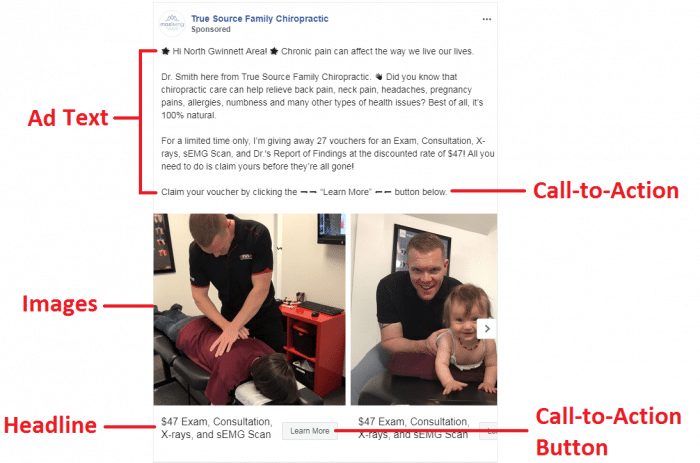
With that in mind, there are three main copy components you need to consider when crafting high-converting and complaint ads: 1) the headline, 2) the copy body, and 3) the call to action.
Here’s what that looks like on a Facebook carousel ad:
Before you tap out a single word, though, you should:
Besides being punchy, good ad copy is buyer-focused and solves a pressing pain point.
So let’s briefly explore this within the context of the three ad copy components
Captivating headline copy instantly hooks an audience and increases conversion rates. This short, snappy line forces you to get to the point of the ad, helping you attract attention while appealing to your ideal prospect’s needs and wants.
The good news is that there are a plethora of Facebook Ad headline formulas you can dig up by doing a Google search.
You’ll find the best headlines:
What about the ad text?
Each ad format allows you to create a certain amount of ad text that further explains your offer and entices your audience. No matter what kind of ad type you choose, the copy should ramp up desire and inspire action.
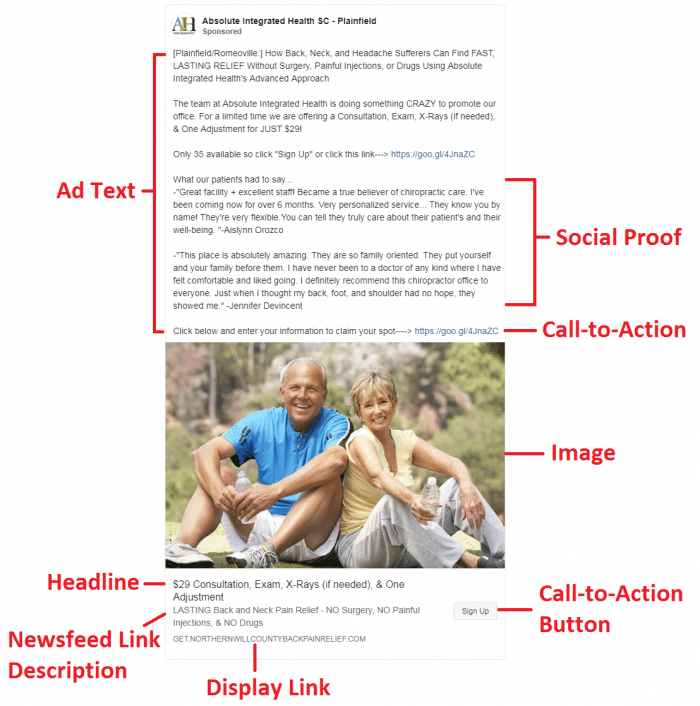
Good ad text leads with a solid hook, reflects the buyer’s struggle by agitating pain points, describes the solution in the form of what you’re offering, highlights the benefits and value, tells the reader what to do next, and supports the visual (i.e. the image or video thumbnail). It’s relatable, it’s specific, it’s relevant, it’s timely, it uses language the audience uses, it’s emotion-driven, and it’s written with the brand’s voice in mind.
In many cases, it also includes social proof, such as the testimonials in the following ad example:
Even if you’re running a video ad, the script needs to contain these elements and the ad text needs to support it.
As you can see in the ad example above, there are two ways to incorporate a call-to-action (CTA) in your ad. The first is by writing CTA copy into your ad text and the second is by selecting an appropriate CTA button when setting up your ad in Facebook’s Ad Manager.
There’s an advantage to both. While the former lets you build a story around the CTA and expand on why people should click the button (or link if you’re adding the URL to the ad text), the latter actually looks like a button—and who doesn’t like clicking those?
So, what constitutes a good CTA?
If you’re looking for additional help, we’ve written an entire post on creating Facebook Ad funnels with an in-depth section on crafting CTAs for both your ads and your landing pages. Be sure to add it to your reading list.
Now let’s look at the visual aspect of a good chiropractic Facebook Ad.

Believe it or not, images matter more than copy. An eye-catching visual stops scrolling in its tracks and entices a user to read the copy.
Great images or video thumbnails take three things into consideration:
Besides being a high-quality image, the visual must match the message in the ad, incite the right emotion, and capture attention. Good images often include a pop of color that contrasts well with everything else going on in a user’s Newsfeed. Keep in mind, the design must capture your target’s eye.
As a chiropractor, you’ll want to use images that reflect what you do, who you are, and the outcomes you offer patients through your treatments. The carousel and single image ads above are great examples.
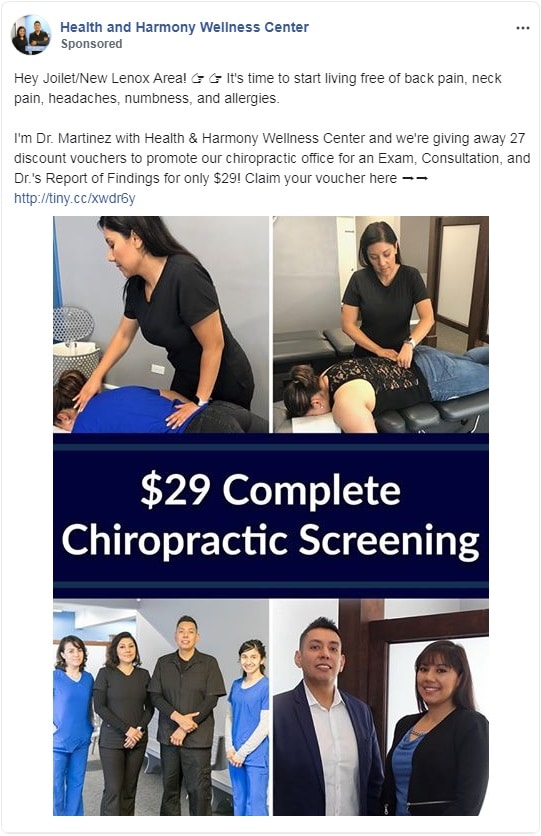
At Ignite Marketing, we like to take up as much Newsfeed real estate as possible by combing images to provide a fuller picture. Here’s an example:
Different ad types call for different ad sizes. Good ads are correctly sized and clear.
Since mobile use had dramatically increased over the years, it’s crucial that a visual works just as well in a mobile Newsfeed as it does with other ad placements. Again, the image should be in a high-quality resolution, clear, and easy to see.
As a final note, be sure to test your image with Facebook’s text overlay tool when adding text to an ad image. Too much text will reduce your ad’s reach and hinder its performance.
Ads are more effective and affordable when you use refined, strategic targeting, and no other advertising platform beats Facebook when it comes to targeting the granular characteristics of your audience.
Some of these options include targeting user profiles based on:
Facebook lets you easily dive into the nitty-gritty of your ideal buyer persona while focusing your brand message and marketing dollars on a market that is highly likely to buy from you.
But when writing your ad copy and developing other assets in your funnel, you also have to consider user intent.
When your target buyer clicks on your ad, they expect to be directed to a page where they can complete the action you’re asking them to take.
Whether that’s…
…you need to ensure there’s messaging consistency between the Facebook Ad and the landing page.
In fact, Facebook won’t approve your ad if the URL is not relevant to the ad copy.
Check out the following example from Optimal Health Sports & Family Chiropractic. Here’s their Facebook Ad for a deeply discounted body contouring package:
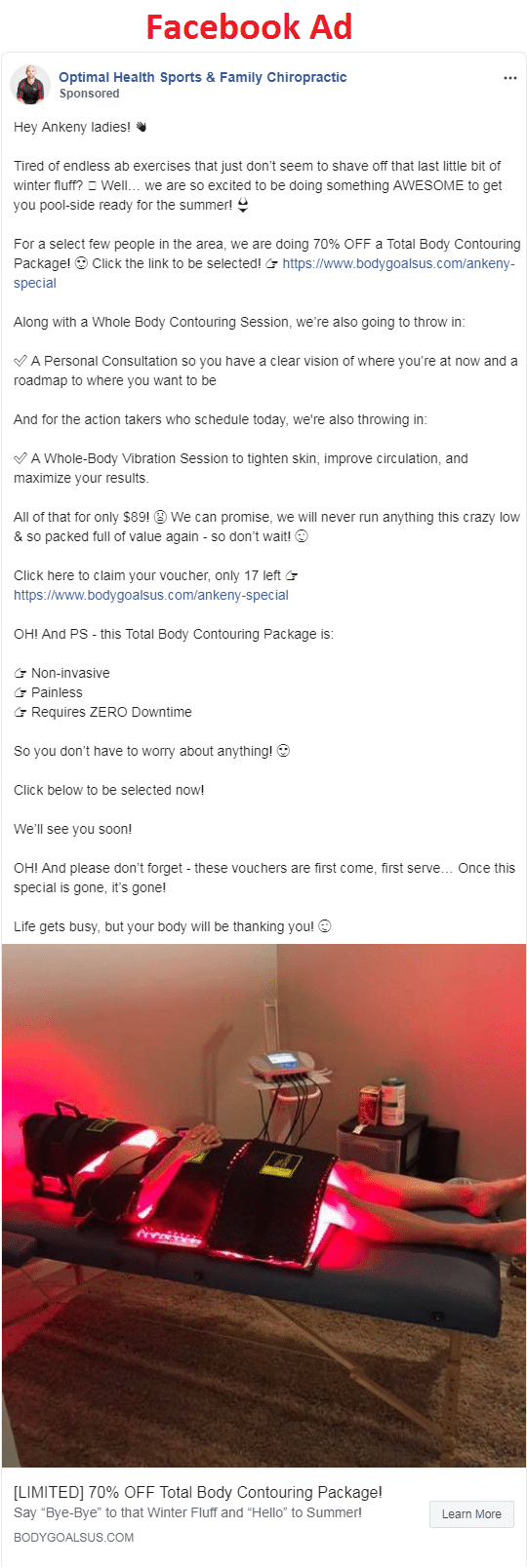
Here’s the matching message and imagery on their landing page:
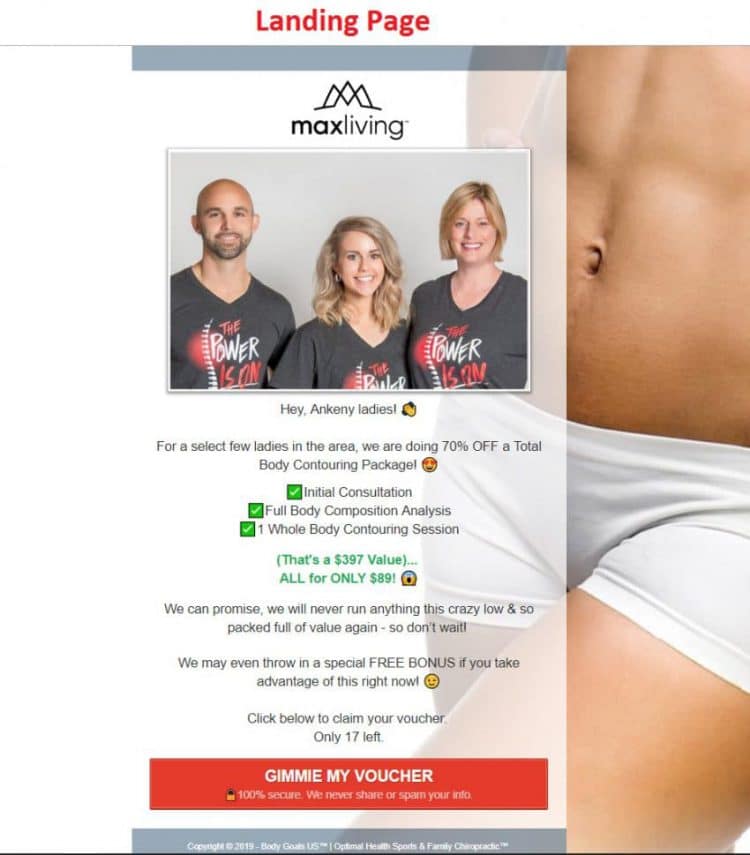
Anyone clicking on the CTA in the Facebook Ad expects to see similar copy on the landing page and be able to claim the offer. With Facebook Ads, messaging consistency and relevancy results in better ad reach and performance.
This brings us to the next factor in creating a great chiropractic Facebook Ad…
 Even if you think your ad is great, your opinion doesn’t mean anything. The only way to truly optimize your chiropractic Facebook campaign’s performance is to split test various elements of your ad.
What should you test?
Your offer: Strong copy will never overcome a poor offer, so make sure you develop a handful of compelling concepts you can test. You might find that different chiropractic offers convert better at different times of the year or that certain audience segments respond positively to specific types of offers. What can you do to sweeten the deal?
Your copy: From the value proposition, headline, ad text, and call to action to the benefits, features, emotional angle, and length (short-form vs. long-form) of your ad copy, every aspect needs to be tested.
Your ad’s design: Since visuals are so important in capturing attention, try a range of images or video thumbnails to see what stands out in your audiences Newsfeed. In addition, consider how the use of emojis in your ad text and headline can change the look and feel of the ad. In one case study, adding an emoji to the ad headline resulted in a 241% higher click-through rate.
Other variables: Besides the ad creative, consider how you might change your targeting, ad placement, campaign objective, ad type, and landing page.
To get the most accurate results, be sure to only change and test one element at a time. You essentially want to fine-tune your campaign until you have a super ad that’s optimized for conversions.
Creating a good chiropractic Facebook ad that’s both compliant and conversion-optimized isn’t easy. However, if you create the right offer, stick to tried-and-true copywriting formulas, choose attention-grabbing visuals, and target the right audience, you’ll have a great foundation for an ad that delivers results. Don’t be scared to play around with your creative and test. You never know when a minor tweak will take your campaign from being average to being unbeatable.
*Disclaimer: Not all of the ads in this post were created by Ignite Marketing. Don’t swipe the ad copy, but rather use it as inspiration for your own creative.
Have a question about Facebook Ads or need help running a campaign? Drop us a line in the comment section below or book a free 15-minute consultation.
One of the primary goals of any chiropractic office is to attract new patients.
On the surface, that sounds simple.
Run a patient acquisition ad on Facebook, right?
Not so fast.
Dig a little deeper and you’ll find yourself knee-deep in the kind of detailed decision-making that makes this humble quest seem like you’re going to war on the Facebook battlefield.
Suddenly you’re asking yourself:
“How will I attract new chiropractic patients into my funnel?”
“Who do I want to attract?”
“What will I offer them?”
“What key performance indicators will I use to measure success?”
“How will I optimize my Facebook ad?”
Etc. Etc. Etc.
Perhaps you’re starting with one of the most elementary questions of them all: what chiropractic Facebook Ads seem to get the best response?
Honestly, that’s a complex question with an even more complex answer.
TL;DR ANSWER: It depends on a number of factors including what kind of response you’re hoping to achieve, whether your targeting is on point, and whether your offer matches patients where they’re at on the buyer journey. We find three offers tend to do incredibly well when positioned correctly: 1) free guides, 2) dinner campaigns, and 3) new patient offers.
Let’s start with some basics before we jump into each of the offers that tend to generate great results for chiropractors.
Before you begin strategizing any Facebook Ad campaign, it’s important to establish what you consider to be an ideal response based on your objective.
Sure, the ultimate goal is to gain a new paying patient, but the reality is that some people aren’t ready yet. They might just be at the start of the buying journey where they’re researching their pain, which means several smaller conversions likely need to happen before they secure an appointment.
Therefore, a response can be any number of actions that indicate interest—not necessarily a booking.
Let’s look at that in the context of the buyer journey.
The buyer journey is a research and decision process that is typically divided into three stages:

(Source: Hubspot)
If an ideal chiropractic patient is in the awareness stage, the individual is searching for information about their pain and looking for potential solutions. At this point, it’s your job to educate them on their problem and introduce your chiropractic services as a possible solution to their needs. During this initial phase, they’re often more inclined to watch an educational video or download a guide than they are to book on appointment.
With that in mind, the response you’re looking for here might be as simple as getting them to watch a video or subscribe to your email list where you’ll then have an opportunity to nurture them into a paying patient. The ad metric you’ll measure as a sign of success will then be video views or email sign ups based on your ad objective.
When they’re in the consideration stage, they’re assessing all solutions. They understand their pain and they’re aware of their options for solving it. They just haven’t decided which solution is best yet. This is when live interactions, patient success stories, comparison content, and free consultations, adjustments, or massages can help sway the prospect your way.
If they’re in the decision stage, they’re already geared up to hit the “Book Now” button. They’re simply waiting for the special offer or deal that’s going to make it worth their while.
So backing up from the ultimate goal of enrolling a paying patient into care, you need to start by asking four critical questions
When working through these questions, be sure to brainstorm several different offer ideas for different audience segments at different stages of the buyer journey.
A key part of identifying which Facebook Ads draw the best response rates for your chiropractic office depends heavily on testing. While some ad campaigns work like a dream for some practices, the same offer bombs for others.
But don’t worry, we’re not going to let you figure it out all on your own.
The good news is that our core clients are chiropractors and we’ve rigorously tested a variety of offers across numerous target segments and locations in the U.S.
As a result, we’re able to share some of the Facebook Ads that generally perform well and the conversion rates you can expect to see.
Without further ado, let’s look at three of those chiropractic offers now.
1. Free Guides or eBooks
eBooks and guides are a powerful marketing tool, yet so few chiropractors use them to attract new patients.
The reality is that these pieces of content have a high perceived value, they’re quick and easy to produce, they help establish your expert status, they build trust, they sell without selling, and they give you an opportunity to build a bank of content for repurposing.
What’s more is that the right topic targeted to the right audience on Facebook can generate excellent response rates.
For example, one of our chiropractic clients specializes in treating scoliosis patients naturally. In the grand scheme of things, that’s a relatively small target segment to pursue. However, the following ad has generated 176 new leads for the practice so far.

We’ve also managed to increase their online enquiries by more than 30% all while building our client’s authority as a chiropractor and scoliosis specialist.
As you can no doubt see, this type of chiropractic offer is ideal for people in the awareness stage of the buyer journey. The idea behind it is that you’re able to collect the email addresses of leads, which allows you to send additional information and offers to help them progress through the three phases and eventually convert them into paying patients. In fact, email marketing has one of the highest ROIs because leads are highly qualified and perfectly positioned to purchase.
Targeted, interesting presentations or workshops combined with free food at a good restaurant tend to be a big hit.
Dinner campaigns not only let you attract leads and educate them on a relevant topic, but they also give you an opportunity to network with your local community and build valuable relationships with prospects.
Now you might be sweating bullets at the prospect of paying for dinner, but consider the return on your investment if just a few people sign up for your services or buy your products at the end of your talk. In addition, limited seating works in your favor by creating scarcity and remaining budget-friendly.
Here’s a great example of a dinner campaign that achieved an amazing response rate:

For dinner campaign ads, we typically see a 15-20% response rate. However, around 60% of prospects who show up to the event convert into care.
There may be a lot of moving parts to this type of chiropractic Facebook Ad offer, but leads are highly qualified and their intent is greater than those who are just starting on the buyer journey. These people have likely done some research on their pain and have determined that attending the dinner is worth the effort to learn more. By the end of the evening, it’s not that difficult to convince them chiropractic is the best solution for their pain.
Perhaps one of the most common offers you’ll see on Facebook is the new patient direct offer. That’s because it produces great conversion rates.
Whether it’s in the form of a voucher, price discount, or special bundle offer, there’s nothing quite like a price cut to help you reach monthly revenue goals. People love special deals, which is why this type of offer is ideal when you want to attract new patients, retain old ones, drive foot traffic through your practice doors, strengthen patient loyalty, and boost profits.

When you’re considering this type of offer, you’ll want to think about the life-time value (LTV) of the patient for your practice. So, if cost per acquisition (CPA) is around $150 and you can make that up in the first visit or two, any additional visits and subsequent purchases effectively cost you $0, thereby increasing overall business profitability.
But what about response rates?
In our experience, these Facebook Ads convert at around 15-20% of leads into paying patients. That’s right, actual bookings. That means for every 100 leads, you can anticipate between 15 and 20 new patients for the month.
Now take into consideration that the average conversion rate on a Facebook Ad in the healthcare industry is around 11%. It’s clear that the three offers we covered above typically exceed average response rates, so you should do well with any of them. The offer you choose to run, however, depends on your answers to the four critical questions we posed at the beginning of this post.
If you want to know more about different types of paid Facebook offers that can help accelerate the growth of your practice, as well as how to create them, be sure to grab a copy of our free guide by clicking the image below.
Creating a Facebook ad campaign can be daunting. With so many factors to consider, there’s major room for error. However, the platform still provides an easy, cost-effective way to promote your chiropractic practice online. Before you hit the eject button and ditch Facebook advertising, test multiple offers to see which produces the best response rates for your office. You might be surprised.
Have a question about Facebook Ads or need help running a campaign? Book a free 15-minute consultation.
Facebook has made it easier than ever to experiment with paid advertising, so if you’re not already engaged in a campaign, it’s time to step into 2019 and give it a shot.
Look, we know it can be overwhelming at first. We know there’s the fear of losing money. We even know it’s easy to get trapped in the cycle of hiring “experts” who leverage the success of others to convince you to buy their ad management package but don’t actually know the first thing about Facebook Ads.
We know because these are common things we’ve heard from our own chiropractic clients.
But here’s the thing: Facebook ads work.
And we know that because we’ve spent a truckload of dinero testing, adjusting, and optimizing campaigns to see what works. It’s why we’re the only Facebook Ads agency that offers an ROI guarantee.
Now you could stop here and spare yourself the hassle of figuring things out on your own by hiring us, but we want to make sure you’re equipped to go the DIY route if you choose.
Besides exploring Facebook ads extensively here on the Ignite Marketing blog, we’ve also created a comprehensive guide packed with offer ideas and a step-by-step process for setting up your own ads. You can download it by clicking the image below:
Facebook has also recently introduced an Ad Library as part of their effort to be more transparent. This is a great way to see what’s happening within the chiropractic industry and spy on your competitors’ ads. Alternatively, you can navigate your way to any Page and click the “See More” link in the Page Transparency section to see existing and previous campaigns.
 While our offers guide gives you the complete setup process, we also want to point out that you shouldn’t only create campaigns in isolation.
In Seducing Strangers (How to Get People to Buy What You’re Selling), Joshua Weltman explains that ads fall into four categories. We’ve covered these types of ads and the psychology behind them in individual posts, but here are the basics:
Here’s an example by Café of Life Marin Chiropractic Center where they’ve used language like “learn a different approach to optimal health” as a way to generate curiosity around their product and service offerings. “Dinner with the Doc” is also fantastic lead bait for attracting people into the top of their funnel.

Here’s an example of how Health and Harmony Wellness Center puts this type of ad into action for their practice:

In the following example, Madalian Chiropractic & Physical Therapy highlight what helps set their practice apart (state-of-the-art rehabilitation) while creating an offer around one of their unique therapy options:

Spark Chiropractic & Acupuncture connects with their audience over a shared sense of patriotism and love of veterans. Besides simply highlighting their shared-values, their campaign allows the community to get involved for a good cause:
 While the first two ad types fall within the realm of direct response, the second two are in alignment with brand marketing. If you look at the sequence, you’ll also notice there’s a linear order to it: 1) introduce your chiropractic products and services to your audience, 2) get people to try and experience your chiropractic care, 3) explain what makes your practice different, and 4) reinforce your patient-doctor relationship through shared values and beliefs.
Even though each type of ad can run as a separate campaign, consider how you can use the entire sequence in your own marketing efforts.
As alluded to above, Facebook marketing usually works when you’re in it for the long run. Without a long-term vision, advertising on Facebook is pretty much a dud or waste of money.
As a chiropractor, you are not shutting down your clinic or office after a few months or having scored a certain number of clients. It’s a career path you’ve (assumedly) taken up for the rest of your life. Your Facebook marketing approach should fall in line with that too.
But that’s not all. You must be wary of or adhere to quite a few other things when reaching out to potential chiropractic clients through a social media site like Facebook.
Here are the steps or the best practices when advertising on Facebook.
If you are a chiropractor who is new to the Internet (let alone the Facebook landscape), people won’t know much about you and, therefore, will not trust you. In such circumstances, it’s critical not to get to selling anything right off the bat. In other words, build familiarity and credibility.
Accomplish that by offering things of value to potential consumers for free. Make sure whatever you provide is truly valuable. It shouldn’t be a precursor or preview to something that’s locked behind a paywall. A free seminar, for instance, is a compelling offering.
By hosting free seminars online or in person, people not just get to know you and your service, but they also start to perceive you as an expert. But for that to happen, you should genuinely provide value. If the seminar helps attendees comprehend their issues and pain points, they will most likely return as paid clients.
Ensure the event’s registration window is small so that there’s a sense of urgency in the air. The landing page for the event must have terms such as “Limited Seats” prominently displayed so that people know you are serious and they feel the urge to sign up.
Focus on building your Facebook page and keeping it active/lively. You need not post content on your Facebook page every hour, but at least do it once every day or two. If you cannot keep up with the frequency needed, hire people for the job. Make sure you have a schedule and stick to it. Do not post multiple times during a particular day and only once during the subsequent days.
Your posts must be diverse and not predictable. Employ a good mix of live videos, posts, images, recorded videos, graphics, etc. To help the page look busy and credible, encourage patients who visit you in your office to check in or leave reviews on your page. If there is a good amount of engagement on your Facebook page already, your patients will be more willing to add to that space.
For any business to flourish in this day and age of YouTube, Instagram, Facebook, etc., videos are essential. And that’s more so the case with health or essential care service providers who don’t have a tangible product to show images of.
When people see you in motion and hear you talk, it becomes easier for them to know and trust you. If you hide behind ads and never show your face, it doesn’t matter how solid your written content and motion graphics are; people will find it difficult to get completely on board or relate with you.

Post different kinds of videos. A live seminar or webinar is one way or type. Other options include patient testimonials, educational content, explainers, office walkthroughs, treatment protocols, or anything you believe is suitable or value-adding to your audience.
It’s essential to keep things simple to grab user attention. You have a very short window to grab a user's attention and intrigue them. Do not add a lot of texts or use multiple pictures and graphics in the same ad. Keep things minimal.
A basic headline, clear image, and a descriptive message are pretty much all that you need to create an effective Facebook ad. Ensure the text font, colors, etc., are in line with your brand’s color palette and overall design scheme.
Misspelled words and/or incorrect grammar won’t cost you a patient, but it will not leave a good impression on them either. Not to mention, people playing grammar police in the comments section and not responding to your ad or enquiring about your services will not look pretty.
If you are not great at proofreading, hire a copyeditor to inspect your text. If you are not a writer and have the budget to accommodate one, outsource the writing part to a professional. They’ll not just ensure your ad copies are error-free but will also set the tone of the texts right.
Make sure your audience knows the actions expected of them after they see your ad. In other words, have a clear call to action in your ads so that your future patients know whether to download, visit your site, like your Facebook page, call to schedule an appointment, etc.
Continually monitor your Facebook ads. Publishing an ad and not keeping a constant watch on it is a wrong approach.
Monitoring your ads not just means checking the analytics or seeing how the ad’s performing in terms of reach or traction but also taking note of the front-end side of things. In other words, if people are commenting under your ads, read those comments and respond or react to them.
Digging into the analytics part routinely will help you comprehend how well your ad performs and the tweaking you may have to do to help the ad serve better. If the ad is performing poorly, you may get insights on why that is so and get the ad on its feet.
See that you don’t get too involved or monitor your ads daily to not get lost in the weeds. Micromanaging will not just eat into your invaluable working hours, but the ad will go through a review each time you make changes to it.
That means the ad would go offline briefly, which could mean the loss of potential clients. Once the ad is live again, it could take time to regain its initial momentum. Checking the ad’s status once a week is usually frequent enough. And alter your ads only if needed or think the changes made would work as an accelerant.

If you want to be successful with your Facebook ad campaigns, learn how the advertising network works. Stay updated with the tool.
Besides learning about the different types of ads, you can incorporate, know that the Facebook algorithm continually changes, impacting how your adverts perform. The ad that brought you leads in hordes six months ago may not accomplish the same thing now. You may have to tweak the ad a bit or come up with a completely new ad to stay in compliance with the updates.
For instance, the format of the ad may not be effective anymore. Video ads could be gaining more traction than image and text-based ads. Be willing to change your advertising methods and approach based on the need of the hour.
As stated earlier, Facebook advertising should not just sell goods and services or boost your gross figures and bottom line. The purpose must also be brand-building. And advertising continually plays a significant role in helping you achieve that.
If your ad is effective enough to grab eyeballs, it could lend your brand some exposure. But for an average individual to remember your name or brand and have it etched in their mind, they must stumble upon the ad more than just once. Only then can you be sure of the potential client recognizing your digital presence and getting reminded of your service when they need chiropractic attention.
If you are serious about Facebook advertising or see the platform constituting a major portion of your online advertising campaign, it’s imperative to know what Facebook expects of you or things it would not want you to do.
Some of the things mentioned below are common sense, but quite a few could be revelations or make you feel glad that you got to know them before you could roll with your first set of ads.
When you or your ads are not in line with Facebook’s advertising rules and guidelines, they won’t be published. And if you keep making the same mistakes, your Facebook account could get banned, and you’ll not be able to advertise on the platform using the particular account anymore. If you are a business with a decent following on the site, an account ban could mean damage beyond repair.
Now that you know how critical it is to stick by Facebook’s advertising guidelines, here are things you should do to not violate Facebook’s advertising policies:
Your ads should not contain questions in the form of text or video inquiries about an individual’s health condition.
For instance, putting forward questions such as “Is depression putting the brakes on your life?” is not allowed. You may change the format or turn the question into a phrase, such as “Depression counseling.” Tread with caution when mentioning specific medical conditions.
Facebook doesn’t like their ads to be in the form of questions or pronouns because they seem too direct and personal. The user who sees the ad feels the platform has been spying on them all this while and could get intimidated, causing them to raise concerns or objections and quit the space for good.
Also, ads on Facebook must not contain information that asserts or denotes personal attributes. That also means not mentioning ethnicity, race, religion, sexual orientation, gender identity, medical condition, financial status, criminal record, etc. If your ads do not have personal pronouns such as “you,” “your,” etc., you’re generally good to go.

Do not promise a cure or even use the term in your ads. Also, statements such as “Chiropractic helps leg pain” would fall in violation of the site’s ad policies. Facebook doesn’t entertain ads that guarantee the efficacy of a health or medical treatment.
Assumptions are not acceptable as well. In other words, “Chiropractic may help with leg pain” also doesn’t work.
Ads that try to sway patients from traditional medicine could get banned. Moreover, certain buzzwords such as “vaccines” are not allowed in your ad text or copy, mainly if the ad propagates against administering the biological preparation.

Facebook doesn’t like its ads to have “before and after” images since it believes most of those “after” photographs are deceptive or not true. It also thinks the “before” picture could create a negative perception in the minds of people who possess those traits.
For chiropractors, it means photos that show people in visible pain, parts of the body circled or highlighted in red (to indicate inflammation) are out of the question.
Your ads should not be “clickbait-y” or misrepresenting. The last thing you would want is to annoy or infuriate your clients with your advertising.
People at the receiving end of your deceptive marketing ploys are not just coming back every time you roll a misleading ad, but they may also spread the word and make it a lot harder for you to acquire new clients in the future.
Facebook’s advertising guidelines and requisites are exhaustive and also tricky. Even if you think you know everything about the rules, you cannot completely rule out an objection to your ad or a revision request. It generally entails a lot of trial and error before you could claim to be entirely on top of the game.

Here is what Facebook ads actually cost in two of our client campaigns, plus the 2026 industry average for medical practices:
| Campaign | Ad spend | Results | Cost |
|---|---|---|---|
| Moss Family Chiropractic: lead ads with a new patient voucher | $221.75 over two weeks | 52 leads, 7 new patients | $4.26 per lead, about $32 per new patient |
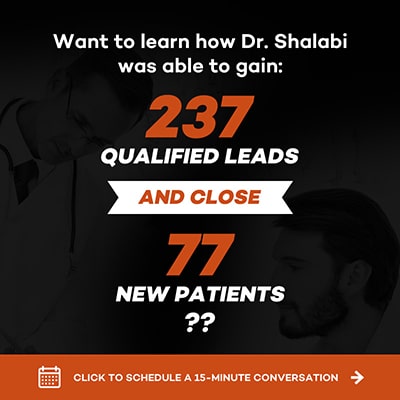
| Health 1st Center: $21 new patient offer plus a patient dinner event | Not published | 237 qualified leads, 77 new patients in three months | 32% of leads became patients |
| Industry average, Physicians & Surgeons (WordStream/LocaliQ 2026) | – | – | $32.14 per lead |
A good starting budget for one location is $20 to $50 a day. To set yours, work backward: if you want 10 new patients a month and about 20% of leads book, you need 50 leads, which is about $1,600 a month at the industry average. See our patient acquisition benchmarks for the full math.
Facebook lets you spend as little as $1 a day to get you in front of around 4,000 people. That number of eyeballs is not bad at all – both in absolute numbers and for the money spent. But it still may not be good enough for the chiropractic industry, wherein conversion rates aren’t very high.
Getting people to visit your site or onto your email list is not that difficult, but making them see you in your office and then come on board for treatments can take considerable time and effort.
In other words, out of the 4,000 people that get to know about your chiropractic service, none may pay a visit to your clinic, and that may not necessarily change even if the number of people viewing your ads increases significantly. And if those people are strangers, you’ll have an even harder time persuading them.
That is why it is so essential to establish yourself or help people get to know you better before you could pitch your services to them.
So, how much should you spend on Facebook ads to promote your chiropractic service? It depends on your region or the market you are targeting. Based on your market size and also your competition, the marketing spend would vary.
As mentioned above, $30 a month is the bare minimum to get some exposure for your service. However, to generate some decent traction and buzz, set aside at least $1,000 a month for advertising. The money spent will afford you valuable insights about ads that work and the audiences who respond. You can scale things from there.

Meta treats health ads more strictly than most categories, and chiropractic ads get rejected for a few common reasons. Stay inside these lines and your ads will run without trouble:
With numerous factors to consider, creating a successful Facebook Ad campaign as a chiropractor can be challenging. However, Facebook still offers one of the most affordable and convenient ways to market your chiropractic practice online. Before you give up and ditch the platform, experiment with different offers to determine which generates the highest response rates for your practice. You might just be pleasantly surprised with the results.
Need guidance on Facebook Ads or assistance with running a campaign for your practice? Take advantage of our complimentary 15-minute consultation. Click here to schedule your appointment today!